Thursday, August 21, 2008

Principles of Puaeconomics Part 3

1.2 The economic way of thinking

e.g. 1: Striking while it's hot [versus] Biding your time

Take a look at this diagram.
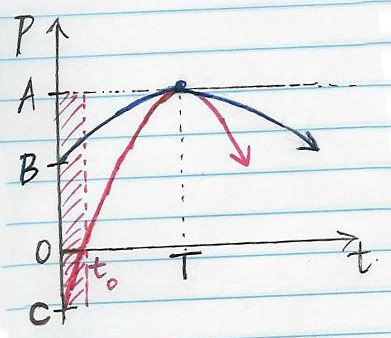
- What the heck is that? (Also, it's a little crooked.)

Well, it is a [crookedly scanned] graph of opportunity versus time. But I used 'P' for prospect instead of 'O' for opportunity... 'cause, you know, 'O' looks like zero...

So I guess the model is something like P = R(t-T)² + A, where R ≺ 0, t ≥ 0,  and positive values of P are good and negative values of P are bad.

There are two curves: the blue one (1) and the red one (2) that depict possible scenarios when it comes to opportunities.

Firstly, when does t = 0? There are several possible explanations:

  • When you first meet the person;
  • When you begin the pursuit, not necessarily marked by any physical move;
  • When you initiate something, ie. a physical move;
  • When the other party initiates;
  • Also, the sucky one, when the other party commits the second one and you are most likely unaware.
  • - (Others I may have not thought of)

Alright, time to start analysing the graphs.

NB: Each individual target will have their own curve where R varies accordingly.

Curve 1: This curve is displaced to the right and starts off positive with an intercept at point B showing that from the very 'beginning', you're good to go. However, it is widely accepted that acting too fast is often seen as desperate/tacky and you are wiser to wait before proceeding. Hence, the curve rises to a universal point of maximum prospect*, P = A, at point (T, A), before logically falling again as it passes T units of time and eventually goes into the negative.

Curve 2: The difference here lies in the coefficient R, which determines the gradient of the slope, and hence the window of opportunity(W), and furthermore, the duration of the no-go zone (0 ≺ t ≺ to).
As shown in the graph, it is definitely a possibility that from the very start, P is a negative value (point C) and hence, any action is at your own expense. This lasts until t =
t0, where P = 0 at the intercept, and then the window of opportunity (ie. for all values of t where P > 0) opens up, but for a shorter duration as the higher value of R has shrunk the window's range of values. 

So what is R? It can be referred to as the magnitude of risk.

     So as ↑R → ↓W

Finally, a common point to be drawn from these models is that as t → ∞, prospects will inevitably reach negative. ie. Do not wait too long.

BUT, *the quadratic model discussed is a very standard and very general take on the concept. For some people, there may not have been a window of opportunity at all for you, and the maximum prospect has already occured below the t axis. Furthermore, there very well may be individuals whose opportunity curve is a sin(t) or a loge(t), and perhaps even asymptotal components.

So, I will conclude this example with a special treat for Marco anybody that is interested.

[Nevermind, I couldn't be bothered parodying an extended response from my Methods 07 Checkpoints, took me long enough to write this up already. Maybe some other time.]

NEXT TIME: More stuff

EDIT: Wow. This is relevant, fascinating, and well its the Gradual Report, so it goes a little wrong in the middle somewhere. Also, it's about economics so time to slap it onto the end of the post as an edit. http://www.youtube.com/watch?v=4upRZ4TEdVM

Labels: ,


.

Wednesday, August 13, 2008

Principles of Puaeconomics Part 2

Introduction to Puaeconomics

Index: 

1.1 Economics: micro, macro and pua

1.2 The economic way of thinking

1.3 Supply and Demand

***

1.1 Economics: micro, macro and pua

"Economics is the science of human choice in which resources are limited in relation to human wants, assuming that individuals are rational maximizers of their own self-interest."
(R.Posner, Law and Economics, p.3)

Let's unpack that.

Firstly, it should be understood that the science of economics is not solely applicable to the expenditure of money. A decision that is "economic" may not always encompass things of this nature. For example, it is likely that you have heard of phrasing such as "the most economic decision" being applied to topics which are not at all to do with money.

Instead, economics revolves around "human wants" and hence, also how you obtain or achieve those ideals. How do you go about getting that dream job? That dream car? That dream girl? That dream cake? one of these is a lie

And importantly, were the 'means' worth the 'end'.

But, it is paramount that you understand "limited resources" must be taken into consideration. For if you had all the money in the world, what couldn't you buy. So, now is the time to do a stocktake of your 'wallet', my students. 

A Breakdown of the Categories of Economics

Micro

  • deals with individual households, firms, industries and markets
  • focusses on: relative prices, allocation of output, employment etc.
  • policy issues include: minimum and maximum pricing schemes, taxes and subsidies, tariffs and quotas on international trade, licensing and other entry restrictions

Macro

  • deals with the economy as a whole, including both the financial and real sides
  • focusses on: the overall price level, aggregate output, aggregate employment and unemployment
  • interest rates and exchange rates
  • policy issues include: monetary policy, fiscal policy, wages or incomes policy

PUA

  • deals with the population of the preferred gender as a whole, including both physical, psychological/emotional and sometimes spiritual components, nevertheless, different markets will be discussed
  • focusses on: the overall afc level, aggregate putting-out, aggregate employment and unemployment of the potential labour pua force
  • examines interest rates and exchange rates of a different nature to that of macroeconomics
  • policy issues include: -TBA-

Of course, only puaeconomics will be discussed in this unit.

NEXT TIME: 1.2 The Economic Way of Thinking

Labels: ,


.

Tuesday, August 12, 2008

Principles of PUAeconomics Part 1

Hi, all

I had a webcomic ready to post but, upon revision [while showering], it didn't make much sense. So... I thought of this [while I was in the shower]. LET'S GO!

***

Unit: PUE8800 - Principles of Puaeconomics

[Our Unpaid] Staff*

Unit Co-ordinator: Jason Ling

Unknowing Contributors: Philip Marquez ('it's too afc'), Danny Yu

*we're hiring!

Objectives

On completion of this unit students should be:

  • familiar with the 'economic way of thinking' about a broad range of individual and relationship choices and decisions;
  • able to apply economic principles to explain and analyse IRI (Institutions of Romantic Intent), their decisions and performance;
  • able to make informed and critical assessment of the public debate on many policy issues;
  • able to proceed to the study of other units of study which have an introduction to puaeconomics as a prerequisite

Unit Structure

Lectures:

Lectures are as long as the lecturer wishes them to be (generally not very long) and start whenever he arrives after the hour. The material presented in each lecture is most easily remembered if recorded in note form.

Lectures are not compulsory, however all information given out in lectures is your responsibility. Students who choose to attend lectures are expected to sit quietly and not disrupt the lecture in any way. That means refraining from applying studies whilst in lectures, no matter how tempting it may be. Disruptive behaviour is not only rude and unfair to other students and staff but is punishable under Statute 4.1 - Discipline of the Monotsh University Calender Statutes.

Tutorials:

Tutorials, which are of one hour duration, will be held each week beginning the first week of lectures (i.e. week commencing February 14). All tutorial questions for the semester are included in your information handout.

Tutorials are designed to help you prepare for the 'examination' and may also include any issues that have been covered in lectures, which you do not understand. Tutorials are the place to ask questions about lecture material and the place to discuss your answers to questions.

To encourage participation in and adequate preparation for tutorials, there will be FOUR tutorial tests during the semester, as indicated in the Unit timetable. The first 15 minutes of the tutorials in which there is a tutorial test be set aside for you to be tested, under exam conditions, by a member of your preferred gender chosen for you by your tutor. :)

If you are sick, or have commitments, which prevent you from attending a tutorial test, you must make arrangements with your tutor to attend another "special" tutorial test session in that week. You must provide your tutor with a copy of a medical certificate if you are sick, or a letter from your employer if work commitments are the cause of your absence. This is to ensure you have not 'chickened out' of talking to that cute girl/guy.

It is your best interest to make a genuine attempt at the person of interest to give your tutor ample material to mark. By doing so you get much needed experience at answering questions under exam conditions, and you should also begin to understand the lecture material, or at least discover what material you do not understand.

Assessment

  • Tutorial Tests: 15%
  • One-hour mid-semester test: 20%
  • Tutorial participation: 5%
  • Final examination: 60%
  • Assessment hurdle: n/a

Textbook and Recommended Reading Material

Textbook: -TBA-

Recommended Material:

  • The Looop's blog (http://thelooop.blogspot.com/)

You are encouraged to read as widely as you can. There are many introductory textbooks which you can use.

***

The unit will begin in the next post. We look forward to your participation.

If there are any questions, feel free to contact the unit co-ordinator via email or MSN Messenger at battousaiv2(at)gmail(dot)com.

Regards,

Jason Ling

Unit Co-ordinator

Labels: ,


.